About LRC
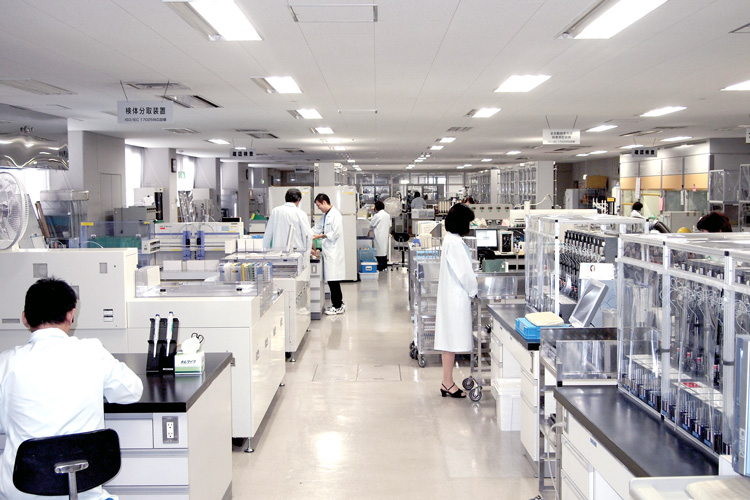
The Laboratory of Racing Chemistry (LRC) established in 1965 is an internationally accredited horse racing doping control laboratory primarily to provide analytical testing services for the analysis of equine biological samples including urine, blood and hair. LRC is the only equine drug testing laboratory in Japan and its main role is to uphold the integrity of horseracing in Japan to ensure a level playing field for all stakeholders. In addition, LRC also provides the parentage verification test to certify the pedigrees of the Japanese horses to protect the breeding industry and racing creditably in Japan. For the international aspects, LRC has long been contributing to the Association of Official Racing Chemists (AORC) and horseracing industry. The AORC is an international organisation with over 100 members worldwide from 26 countries with the major objectives of supporting racing chemists/scientists in the advancement in doping control in horseracing and other regulated animal sports as well as enhancing the quality of drug testing for the racing laboratories.
Since
1965
Horse racing in Japan
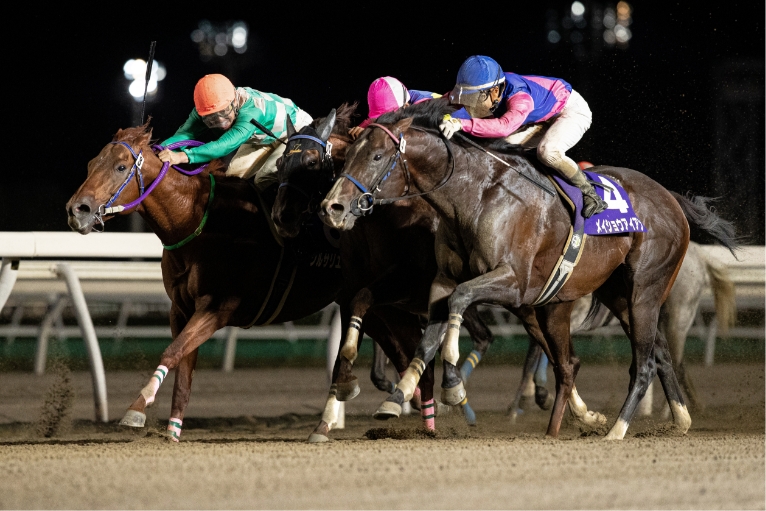
In Japan, the use of performance-enhancing or performance-suppressing substances and the misuse of therapeutic medications on horses for racing or under training are strictly prohibited under the Horse Racing Law with the objectives to protect the integrity of horseracing and welfare of the horses. The prohibited substances include but not limited to anabolic androgenic steroids, narcotic analgesics, stimulants, CNS depressants, painkillers, anti-inflammatory drugs, diuretics, and local anesthetics.
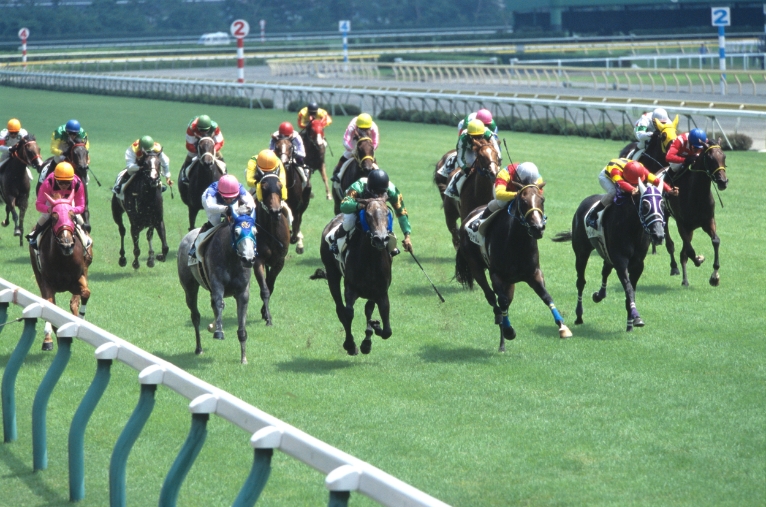
In general, post-race urine samples from horses being placed in the first three and selected by the stewards of the race meeting will be collected and each divided into ‘A’ and ‘B’ samples by the racing officials under the witness of the respective trainer or his/her representative. In the event that urine cannot be collected within the designated period, blood (‘A’ and ‘B’) will be taken instead. Both ‘A’ and ‘B’ samples are properly sealed and then delivered to LRC. The ‘A’ samples will be analysed by LRC for the presence of prohibited substances. If the ‘A’ sample is tested positive, the ‘B’ sample will be automatically tested by the same laboratory in the presence of the witnesses from the academic authorities. If the same substance(s) is detected in ‘A’ and ‘B’ samples, it will be considered as a violation of relevant regulations for prohibited substances and medications under the Horse Racing Law. The horse concerned will be disqualified and suspended from racing for a fixed period of time. Apart from post-race samples, out-of-competition samples, feed samples and other miscellaneous samples will also be tested by LRC.
Professionalism
LRC has a total of more than 65 full time and more than 25 part time staff including 20 PhD holders. LRC is an active member laboratory of the AORC and currently has 1 Fellow member, 7 Professional members and 1 Affiliate member within the AORC. The professional staff of the LRC gave scientific presentations at various international conferences regularly and have produced more than 180 peer-reviewed scientific publications.
International reputation
LRC’s Drug Analysis Department has been accredited to the international standard ISO/IEC 17025 (General requirements for the competence of testing and calibration laboratories) by the Japan Accreditation Board in the field of Biological Sciences Testing since 2004 and is currently accredited to its latest version of 2017, demonstrating our technical competence and robust quality management system in the area of forensic testing.
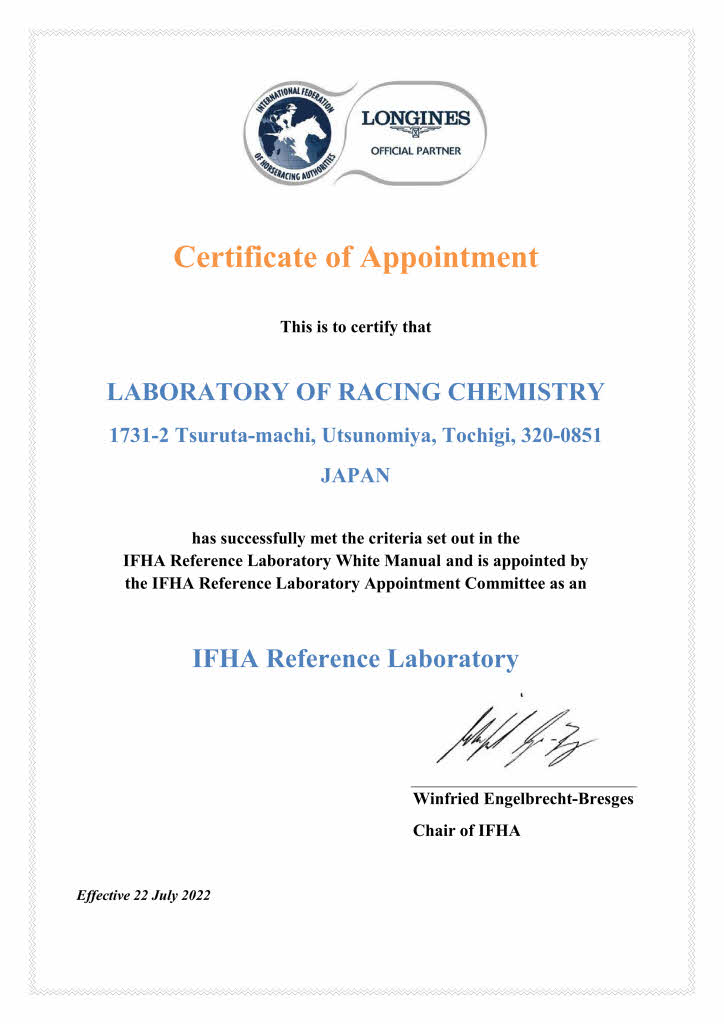
In February 2021, LRC was approved by the Fédération Equestre Internationale (FEI) as one of the five FEI Approved Laboratories in the world for the testing of equestrian samples from FEI-regulated events and was subsequently designated by the FEI as the sole laboratory for testing Pre-Arrival Testing samples and Equine Anti-Doping and Controlled Medication samples for the Tokyo 2020 Olympic and Paralympic Equestrian Games held in the summer of 2021. In July 2021, LRC was provisionally appointed by the International Federation of Horseracing Authorities (IFHA) as an IFHA Reference Laboratory. After the successful completion of the IFHA on-site assessment, LRC was fully appointed to become the 6th IFHA Reference Laboratory in July 2022. LRC is currently one of the only four laboratories worldwide attaining both appointments of the FEI Approved Laboratory and the IFHA Reference Laboratory status. In addition, LRC provides professional testing services for overseas racing and equestrian authorities for the analysis of their “A” and “B” samples. Further, LRC has been listed by various racing authorities such as Racing Australia, British Harness Racing Club and Malayan Racing Association as an official racing laboratory for reserve portion / B sample analysis.
For international contributions, LRC contributes to the Asian Racing Federation Drug Control Committee (ARFDCC) and different committees of the AORC. In addition, LRC has been responsible for compiling the AORC Positive Case Reports and the AORC Annual Sample Statistics Report for the AORC and its members worldwide. Furthermore, LRC oversees the AQAP Negative Sample Exchange Programme for the AORC Asian Section.
In summary, the above achievements clearly demonstrate that LRC’s international reputation and testing capabilities are internationally recognized.
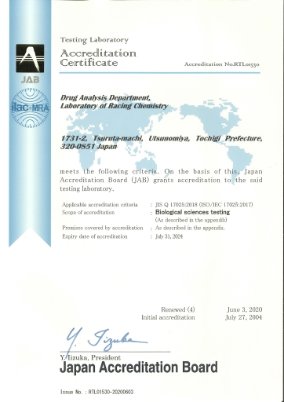
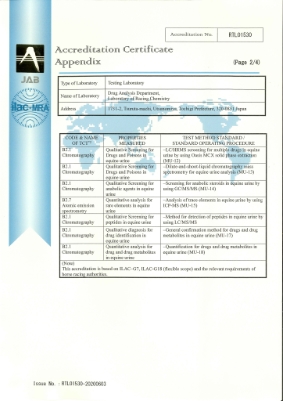
Accreditation of
RTL01530 covers
equine drug
analysis in body
fluids and hair